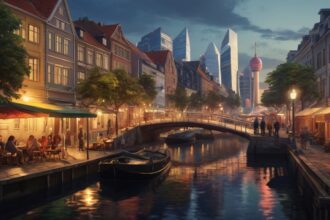
The air in Copenhagen is crisp, carrying the scent of rain-soaked cobblestone and freshly brewed coffee from a street-side café. Bicycles glide silently along dedicated lanes, their riders undisturbed by the chaos of honking horns or the suffocating presence of exhaust fumes. In the contrast of Copenhagen vs New York, time moves at a slower, deliberate pace. The city, with its narrow streets and orderly society, feels like a well-kept secret—one that whispers rather than shouts.
The Danish capital, a city defined by its hygge lifestyle, offers a vision of urban life that is designed around human well-being. People here do not rush to work in a frantic bid to make ends meet. Instead, they bike past historical buildings, through charming parks, alongside tranquil canals, their mornings punctuated not by stress, but by a sense of unhurried purpose. The infrastructure prioritizes quality of life, from its public transportation system to its well-maintained green spaces.
On a typical evening, Copenhageners gather in candle-lit cafes or along the waterfront, savoring a sense of communal belonging. There is a harmony in the air, one fostered by high levels of social trust and an ingrained belief that life should be lived, not merely survived. It is a city of modesty, where excess is frowned upon, and where even the wealthy live with an understated elegance that shuns extravagance.
In contrast, New York City is an unrelenting force. The air is thick with ambition, impatience, and the ever-present roar of sirens and shouting voices. Its skyline is jagged and piercing, an endless collection of steel and glass monoliths reaching for the sky, each a monument to someone’s dreams or someone else’s ruin. In New York, the sidewalks pulse like the arteries of a living organism, the people scurrying through them like blood cells feeding the heart of capitalism itself.
New York is defined by its relentlessness. It does not wait for anyone. Here, a moment of hesitation can mean lost opportunities, missed connections, or being left behind. The people are driven, ambitious, but often exhausted. Every conversation seems to carry an air of urgency, as if every second must be justified by productivity. The city is alive with possibilities, but it is also ruthless in its demands.
For all of Copenhagen’s order, safety, and stability, it lacks a certain raw energy. It is a city where dreams are nurtured slowly, where the pursuit of happiness is restrained by the need for balance. People are comfortable, but are they truly alive? Are they burning with the same insatiable hunger that fuels New York’s streets, or are they merely satisfied, sedated by the predictability of a system that works?
New York, on the other hand, devours the weak. It is the city where only the relentless thrive, where success is intoxicating but failure is a merciless abyss. People live for the highs, the victories, the moments that feel like standing on top of the world. But at what cost? Is the price of ambition loneliness, exhaustion, and an endless cycle of chasing something just beyond reach?
Every street in New York tells a different story. The financial giants of Wall Street move billions with a single decision. The artists of Brooklyn sketch their struggles on subway walls and in forgotten corners of the city, hoping for their moment of recognition. The immigrants of Queens build new lives in a city that welcomes them with open arms yet often offers them nothing but the scraps of opportunity. The theater actors in Midtown dream of their big break, waiting tables by day and performing by night. This is a city of relentless movement, where every person is an individual force striving against the current.
Copenhagen, in contrast, offers a different kind of richness—not in wealth, but in life itself. Here, workers are not defined solely by their professions but by their ability to enjoy their leisure. A Dane is not just an employee; they are a cyclist, a café-goer, a family member, a friend. The work-life balance is sacred, with strong labor protections ensuring that life is lived outside of office walls. The weekends are spent by the sea, in small summer houses, or simply enjoying the pleasures of life that require no grandiose achievement—just presence.
One city ensures peace; the other demands battle. But which life is more fulfilling? The answer depends on what one values more: the promise of stability or the thrill of uncertainty.
In Copenhagen, your life may be predictable, structured, and filled with contentment, but will you ever feel the electrifying pulse of standing on the edge of greatness? In New York, you may live every day on the brink, fighting for every inch of success, but will you ever experience true peace, or will the chase consume you whole?
And so the question remains: Would you rather live comfortably, knowing your days will be predictable yet stable, or would you risk everything for the chance to stand atop the chaos, knowing the fall could be just as great as the rise?