
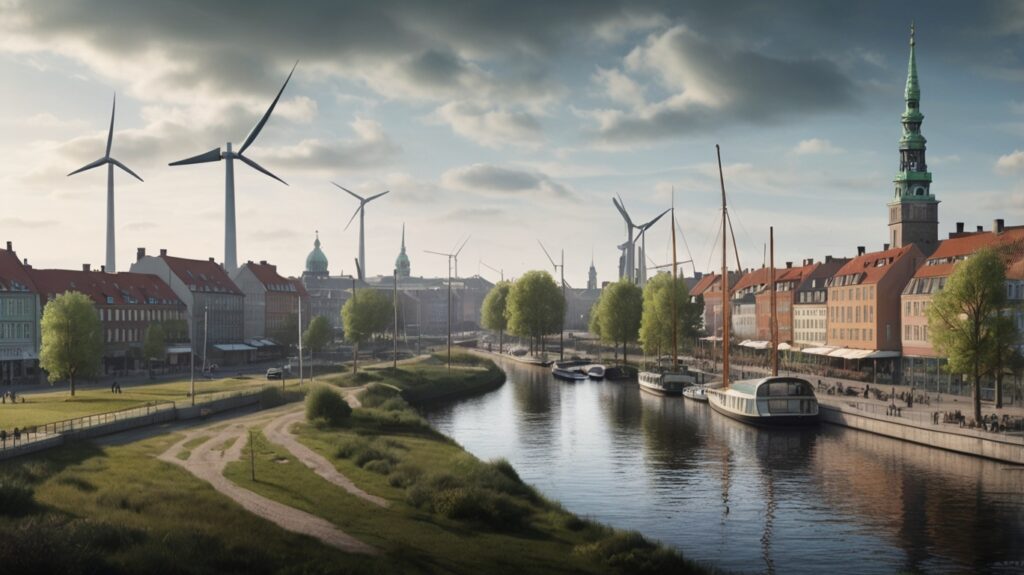
Green Denmark has long been celebrated for its environmental consciousness, often hailed as one of the world’s cleanest countries. This reputation is backed by impressive achievements: the nation has halved its carbon emissions over the past 25 years and aims for a 70% reduction by 2030, with full carbon neutrality targeted by 2050. Copenhagen, the capital, aspires to become the first net-zero green city globally within a few year
A Recent Decline in Environmental Rankings
However, recent evaluations suggest that Denmark’s environmental progress may be losing momentum. In the 2024 Environmental Performance Index (EPI), Denmark dropped from its previous top position to 10th place. This decline is attributed to challenges in reducing emissions from hard-to-decarbonize industries and a slowdown in the pace of decarbonization.
Lingering Environmental Challenges
Despite a strong commitment to sustainability, Denmark faces significant environmental challenges. According to the 2024 EPI, the country ranks 37th in Ecosystem Vitality, with notable concerns in marine habitat protection (82nd) and protected area effectiveness (149th). These figures indicate that while Denmark has made strides in certain areas, there is considerable room for improvement in others.
Air Quality Still Below WHO Standards
Moreover, Denmark’s air quality, though better than many nations, still falls short of the World Health Organization’s recommended levels. A recent report highlighted that only seven countries meet these standards, with Denmark not among them.
Urban Innovation: Copenhagen’s “Five-Minute City”
Urban development projects like Copenhagen’s Nordhavn district exemplify Denmark’s innovative approaches to sustainability. Dubbed the “five-minute city,” this neighborhood is designed to provide residents with all essential services within a short walk, reducing reliance on cars and promoting eco-friendly living. While this model has garnered international attention, it also raises concerns about affordability and social inclusivity.
A Critical Moment for Denmark’s Green Future
Denmark’s environmental journey serves as a reminder that initial successes must be sustained through continuous innovation and commitment. As the nation grapples with emerging challenges, it prompts a critical reflection:
Is Denmark’s current environmental strategy sufficient to overcome these hurdles, or is a more radical approach necessary to reclaim its position as a global leader in sustainability?
Important Links:
2024 Environmental Performance Index (EPI) – Yale University
- https://epi.yale.edu
- (Denmark’s environmental ranking, methodology, and detailed sub-scores)
OECD Environmental Review: Denmark
- https://www.oecd.org/environment/country-reviews/environmental-performance-reviews-denmark.htm
- (Detailed analysis of Denmark’s environmental policies and challenges)
EU Environment Statistics: Denmark
- https://ec.europa.eu/eurostat/statistics-explained/index.php?title=Environment_statistics
- (Official EU environmental data, including emissions, biodiversity, and air quality)
Danish Ministry of Climate, Energy and Utilities
- https://en.kefm.dk
- (Government’s official climate targets, strategies, and renewable energy projects)
World Health Organization (WHO) – Air Quality Report
- https://www.who.int/data/gho/data/themes/air-pollution
- (Comparison of Denmark’s air quality with global health standards)
Danish Environmental Protection Agency (Miljøstyrelsen)
- https://mst.dk/english/
- (National policies on nature, water, air, chemicals, and circular economy)
You May Like:
-
How Danish News Built a Surprisingly Calm Fascinating Media Culture
News & coffee: Imagine a quiet morning in Denmark. The sky is grey.You sit with a warm cup of coffee. Then you open the news. The headlines talks about politics, schools, the weather, and the world.Some stories are serious.Some stories talk about problems. But the coverage still feels calm. No shouting.No loud drama.Just clear information.…
-
Why Proven Ways Make People Secure and Happy
Denmark built its system slowly. Leaders worked step by step. Their goal was simple. Life should feel fair and stable. Because of this, rules do not change very often. As a result, people trust the system. Meanwhile, the United States showed a different style during the Trump years. Politics moved fast. Big choices came quickly.…
-
I Spent 7 Days in The Great Danish Winter Darkness
Darkness is the first thing you notice in a Danish winter. It is not silence. Instead, it is a quiet that slowly settles over everything. Streets feel calmer. Houses glow softly from inside. Even the air feels still. Winter changes the rhythm of Denmark. The sun rises late. Sometimes it hides behind clouds. When daylight…
-
How Kids Explore Risky Play Better
Playgrounds in Denmark often surprise visitors. Many people expect soft floors and very safe equipment. However, Danish playgrounds feel more adventurous. Children climb tall wooden towers. Others balance on logs or rope bridges. Some build huts with planks and ropes. At first, the space may look messy or even risky. Yet the design is intentional.…
-
How Denmark Builds a Powerful World of Trust
Introduction Have you ever walked down a Copenhagen street and noticed a pram (baby carriage) left outside a café, or seen children playing freely without adults hovering? For many visitors, these are striking signs that something about Danish life feels different. It’s not just safety, it’s trust—and more importantly, this trust is taught from a…
-
The Welfare Myths: Hidden Truths About Life in Denmark
Introduction to Copenhagen: Beyond the Stereotypes When most people think of Copenhagen, a few familiar images pop up: bicycles, colorful houses along the canal, happy people, and maybe even fairy tales written by a certain famous author. But here’s the truth—you might be wrong about Copenhagen. For travelers, expats, and curious readers, the Danish capital…
P20250406-008


