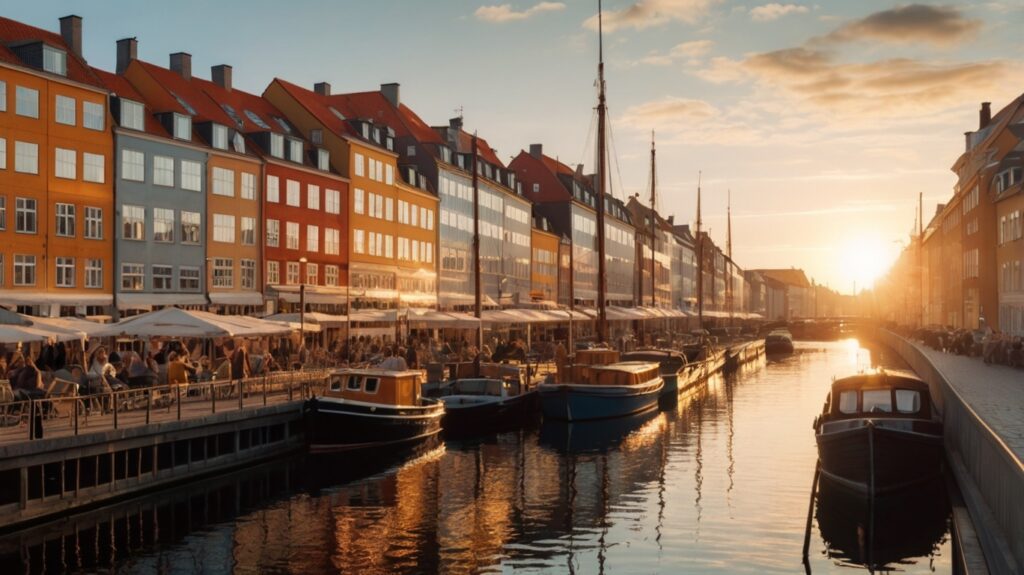
Where is Copenhagen?
You might be tempted to answer quickly: it’s the capital of Denmark, nestled in Northern Europe on the edge of the Baltic Sea. And technically, you’d be right. But the truth is, Copenhagen is more than just a point on the map.
Copenhagen is where vision meets tradition. Where city life breathes with nature. Where the future isn’t feared—it’s designed.
A Hidden Jewel Between Continents
Geographically, Copenhagen sits on the eastern coast of Denmark’s largest island, Zealand, just across the Øresund Strait from Sweden. In fact, thanks to the iconic Øresund Bridge, it’s the only capital city in the world where you can hop on a train and be in another country in under an hour.
But its location offers more than connectivity. It’s a crossroads of culture, commerce, and creativity. Scandinavia meets Europe here—not just physically, but spiritually. It’s a place that blends cozy charm with cutting-edge innovation.
From Viking Harbor to Visionary Capital
Originally a humble fishing village known as Købmændenes Havn—“Merchants’ Harbor”—Copenhagen’s transformation into a global capital is nothing short of epic. This isn’t a city that inherited greatness. It built it.
From royal castles to resistance movements, from medieval trade to modern design, Copenhagen has always known how to evolve. After being bombarded during the Napoleonic wars, it rebuilt. After fires and plagues, it reimagined. Today, it’s not just one of Europe’s safest cities—it’s also one of its smartest.
This is a city that believes problems are opportunities in disguise.
A Green City That Actually Lives Its Values
If you’ve ever wondered what a sustainable future looks like, just look at Copenhagen. The city is on track to become the world’s first carbon-neutral capital by 2025—and they’re not just talking about it, they’re doing it.
- Over 60% of Copenhagers commute by bicycle every day.
- Urban planners are turning old industrial sites into green havens and recreational spaces.
- Even the harbor is so clean, you can swim in it—right in the city center.
It’s not just sustainability—it’s a lifestyle. And it’s inspiring cities across the globe.
A Creative Pulse That Never Stops
Copenhagen is a city of ideas. It’s where Scandinavian design was born, where new Nordic cuisine became a global phenomenon, and where architecture is redefined with every new skyline silhouette.
Want inspiration? Walk through the cobbled streets of the Latin Quarter. Sip coffee in a former warehouse in Islands Brygge. Watch an outdoor ballet at the Royal Theatre with the harbor as your backdrop.
It’s a place where innovation happens—not in boardrooms, but in everyday life.
So… Where Is Copenhagen, Really?
Is it a GPS coordinate? Yes. But it’s also a feeling.
Copenhagen is where the world’s best ideas come to life—with clean air, good coffee, and a quiet sense of confidence. It’s not just where Denmark’s heart beats—it’s where Europe looks when it wants a glimpse of what comes next.
Now, ask yourself:
If you had a chance to spend a season in one European city, would you choose:
- A) A city with centuries of history and a bold, green vision for the future—like Copenhagen?
- B) A place still trying to figure out what it wants to be?
Important Links
📍 1. Geography & Location
- Copenhagen’s geography: Located on eastern Zealand and Amager, facing the Øresund strait toward Malmö, Sweden
- Amager Island details: Copenhagen partially sits on Amager, home to the airport and natural reserves .
🌉 2. Øresund Bridge & Connectivity
- Øresund Bridge overview: 8 km combined rail and road bridge, plus a 4 km tunnel, linking Denmark and Sweden since July 2000
- Regional impact: Enabled significant commuter integration — daily crossings increased tenfold by 2010, linking economies and labor markets
🌿 3. Sustainability & Carbon Neutrality Plans
- Copenhagen 2025 Climate Plan: Ambitious roadmap involving zero‑emission construction, energy partnerships, and urban networks like C40 and CNCA
- Progress toward neutrality: Over 40% emissions reduction since 1990; ~75% drop since 2005, with target of 80% by 2025 — though full neutrality may be delayed to 2026–28
📚 Additional Research
- Polycentric governance study: Examines Copenhagen’s collaborative climate approach and remaining gap to meet CO₂ neutrality
- CopenHill innovation: A ski slope atop a waste-to-energy plant, showcasing urban-environmental creativity
You May Like:
-
How Danish News Built a Surprisingly Calm Fascinating Media Culture
News & coffee: Imagine a quiet morning in Denmark. The sky is grey.You sit with a warm cup of coffee. Then you open the news. The headlines talks about politics, schools, the weather, and the world.Some stories are serious.Some stories talk about problems. But the coverage still feels calm. No shouting.No loud drama.Just clear information.…
-
Why Proven Ways Make People Secure and Happy
Denmark built its system slowly. Leaders worked step by step. Their goal was simple. Life should feel fair and stable. Because of this, rules do not change very often. As a result, people trust the system. Meanwhile, the United States showed a different style during the Trump years. Politics moved fast. Big choices came quickly.…
-
I Spent 7 Days in The Great Danish Winter Darkness
Darkness is the first thing you notice in a Danish winter. It is not silence. Instead, it is a quiet that slowly settles over everything. Streets feel calmer. Houses glow softly from inside. Even the air feels still. Winter changes the rhythm of Denmark. The sun rises late. Sometimes it hides behind clouds. When daylight…
-
How Kids Explore Risky Play Better
Playgrounds in Denmark often surprise visitors. Many people expect soft floors and very safe equipment. However, Danish playgrounds feel more adventurous. Children climb tall wooden towers. Others balance on logs or rope bridges. Some build huts with planks and ropes. At first, the space may look messy or even risky. Yet the design is intentional.…
-
How Denmark Builds a Powerful World of Trust
Introduction Have you ever walked down a Copenhagen street and noticed a pram (baby carriage) left outside a café, or seen children playing freely without adults hovering? For many visitors, these are striking signs that something about Danish life feels different. It’s not just safety, it’s trust—and more importantly, this trust is taught from a…
-
The Welfare Myths: Hidden Truths About Life in Denmark
Introduction to Copenhagen: Beyond the Stereotypes When most people think of Copenhagen, a few familiar images pop up: bicycles, colorful houses along the canal, happy people, and maybe even fairy tales written by a certain famous author. But here’s the truth—you might be wrong about Copenhagen. For travelers, expats, and curious readers, the Danish capital…
P20250419-001