It happens to nearly any Americans who steps off a plane in Europe. The first realization strikes as they navigate the airport: Why is everyone walking so much? Then, the train glides smoothly into the city center, where pedestrians, cyclists, and trams weave through the streets with practiced efficiency. The second realization follows swiftly: Where are all the cars?
For Americans raised in sprawling suburbs and cities built around the automobile, the experience is disorienting. In the U.S., a car is not a luxury; it is a necessity. Daily life is dictated by commutes through congested highways, endless parking lots, and the tyranny of gas prices. But in Europe, an alternate reality exists—one that challenges the very foundation of America’s transportation culture.
The European Cycle Route Network: A Silent Revolution
Across Europe, an extensive web of cycle routes connects cities, towns, and even remote countryside. This is not just a network of bike lanes tacked onto car-dominated roads; it is a parallel transportation system that renders cars unnecessary for millions. The EuroVelo network, spanning over 90,000 kilometers across the continent, allows a person to travel from the Arctic Circle to the Mediterranean, from the Atlantic to the Black Sea, all without stepping into a car.
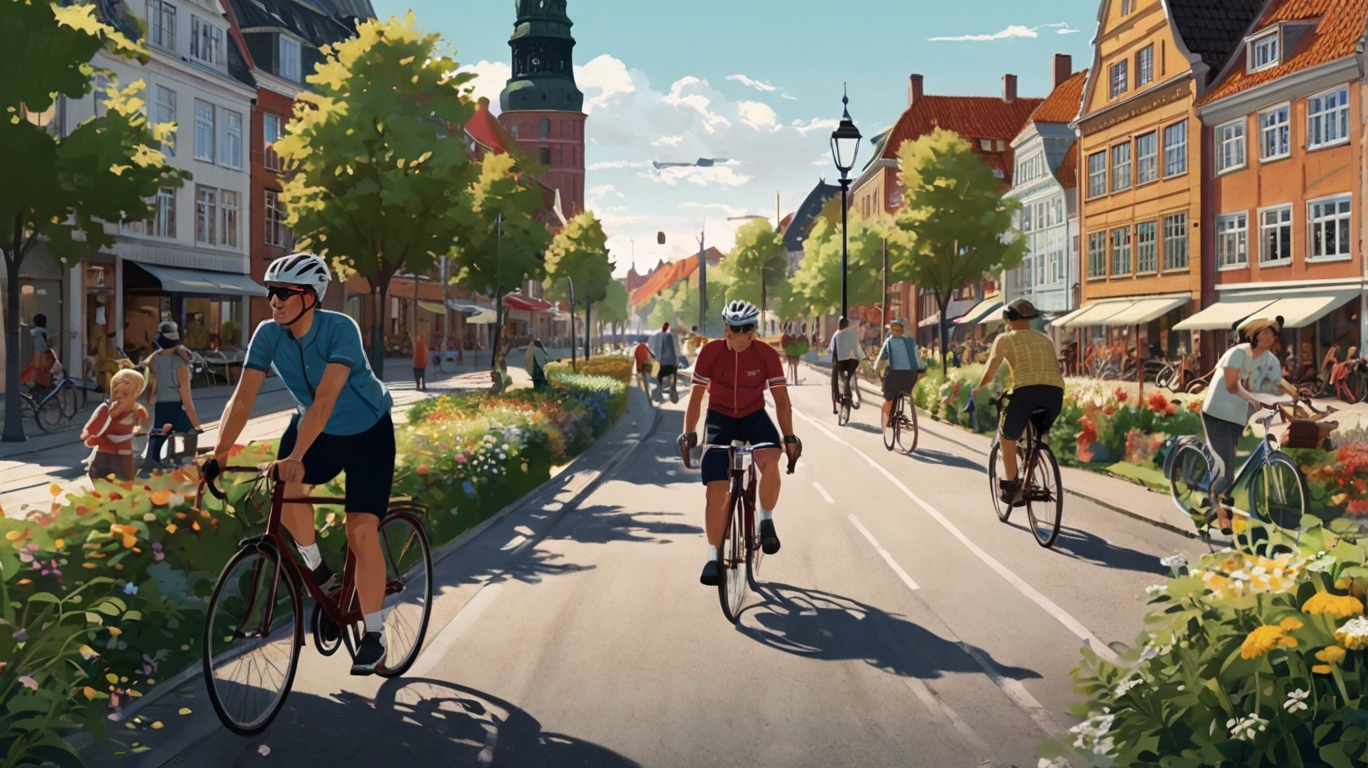
It is not just for recreation. In cities like Copenhagen, Amsterdam, and even Paris—historically known for its chaotic car traffic—cycling has been integrated into the daily rhythm of life. Bike highways, protected lanes, and extensive infrastructure ensure that cyclists are prioritized, while cars are increasingly marginalized. The shift is not just cultural but structural: entire cities have been redesigned to favor two wheels over four.
A Harsh Reality Check for Americans
For an American, stepping into this world can be a gut-punch. In the U.S., even the most “bike-friendly” cities—like Portland or Minneapolis—pale in comparison to their European counterparts. American cycling infrastructure is often an afterthought, a patchwork of disconnected lanes that leave cyclists vulnerable to speeding cars. Commuting by bike in most U.S. cities is an act of defiance, not a norm.
The shock deepens when Americans realize that many Europeans live without ever owning a car. Public transit, cycling, and walking provide enough mobility that a personal vehicle becomes redundant. It is a stark contrast to the United States, where even the simplest errands—getting groceries, taking children to school, visiting a friend—often require a car.
The excuses Americans use to justify car dependence begin to crumble in the face of Europe’s reality. “Our cities are too spread out,” they say—yet many European cities were also built with cars in mind and have since been reimagined. “Public transit isn’t good enough,” they argue—but transit only improves when cities stop catering exclusively to cars. “Biking is unsafe,” they insist—yet safety improves dramatically when infrastructure prioritizes people over vehicles.
The War on Cars is Already Won—Just Not in America
In much of Europe, the war against car dominance is not a future goal; it is a battle already won. Cars are being phased out of city centers, not through government mandates, but through pragmatic policy shifts. Congestion charges, pedestrianized streets, and bike-first design ensure that driving is an inconvenience rather than a default.
Meanwhile, in America, attempts to challenge car dependency are met with fierce resistance. Proposals for bike lanes spark outrage from suburban commuters who see them as an assault on their way of life. Public transportation projects are gutted by budget cuts and bureaucratic inefficiency. Urban sprawl continues unchecked, with massive highways slicing through neighborhoods, reinforcing a cycle of dependency that seems impossible to break.
But Europe proves otherwise. It proves that cars are not inevitable, that cities can function—and even thrive—without them. The American dream may be paved in asphalt, but Europe’s future is being built on two wheels.
The question now is: How long can America ignore the proof?